
When we last spoke, it was hosing down in Keetmanshoop, and we had just done a few week’s laundry. It was also Saturday, and Jean had very cleverly checked out with the Info office where we could watch the Natal Sharks/Golden Lions rugby match. No problem, the lady phoned her buddy at the “Bird’s Nest Bed and Breakfast” and it was all laid on. We were made very welcome, it was only us and the landlady watching, and given a cup of coffee – money didn’t come into it, we were made to feel as house guests. That gave us a very nice feeling, which was just as well, because after watching Natal losing by 1 point to a bunch like that, we needed to feel good about something. In any event we went back to the camp, and stuck pins in effigies of Tappe Henning, the ref., various unnamed linesmen, Gavin Lawless, and of course Louis Luyt. The new bottle of Hankey Bannister took its own punishment.
That night the local skellums cut the wire and made an abortive raid on the camp, to be chased off by the night watchman. It was very good to see the action taken by the local police (very correct- a swart ou and a wit ou) and on a Sunday morning too! They were taking statements and measuring footprints, and, when the wit ou said,” Do not worry Sir, we will get them” we actually believed him. Anyway, it was still raining so we loaded up all the wet laundry and headed for Luderitz.
As we drove, we realised that the desert we had seen was only semi-desert, and as we passed into the Sperrgebied area we realised that we were in real desert (Sperrgebied means “Go and find your own diamonds somewhere else”). In fact, it was rather nice, as we crossed the prohibited area (which, for the unimaginative, is what Sperrgebied really means), a lone Gemsbok crossed the road and wandered off over the sands.

Shark Point
We arrived at Luderitz in really pleasant sunny weather. The caravan park is on Shark Island, now a peninsula, which is the Southern boundary of the port. Its situation is magnificent, but sadly it’s somewhat run down. We set up camp, dried our washing in record time, and sat and watched the sun go down warmed by a balmy off shore wind. By 01:30 the next morning our balmy wind had turned into a raging hurricane, and our rally awning had to be secured and lashed down in double quick time, (we seamen are used to these things), nevertheless it had been a very good day.

Flamingos with Halifax Island in the background
The next day, (and a few after), dawned with quite heavy fog, and a definite chill, but, strangely enough, it was quite nice. There we were, on this rocky peninsula, with sea on either side. The Diaz Point Light House was sounding its fog horn (or fog whatever) and the bells on the channel buoys were tolling in the swell. Every now and then we could pick up the chunter of the diesel engine of a fisherman going in or out. (One interesting point, for our mariners, we never once heard a fog signal from the fishing boats – some of which were a fair size.)
All in all, we stayed a week in Luderitz Bay (or, as we locals call it, Luderitzbucht) . It’s a fascinating place. Very German in its history and culture, and, of course, a lot of its history revolves around diamonds. The ghost town of Kolmanskop, just outside Luderitz, is very interesting, but totally controlled by Namdeb (Namibia De Beers Diamonds).

Kolmanskop

Kolmanskop – A Renovator’s Dream
Modern Luderitz, although obviously, not without influence from Namdeb, relies now on fishing. There are a number of large fishing concerns there, the largest being the ubiquitous Pescanova. Fish are brought in and processed and frozen at three large processing plants. The port is starting to expand, and they are currently building a new berth, which will increase the small container ship capacity and also cater for a coastal tanker. Maersk Line seem to be well ensconced and run in the Arktis Hunter as a feeder vessel. As usual, they have done away with the local agent that they started with and set up their own office.

Luderitz harbour. “Arktis Hunter” to the left
We wandered around during our week’s stay. We visited Diaz Point and the Atlantic Coast – impressive but also cold and bleak. We had numerous cups of tea and coffee at the various coffee shops that also served some very interesting cakes, and we ate plenty of fish and chips from the “chipper” outside the dock gates. All the fish there is frozen and, although we bought plenty of it at a very cheap price (Kingklip cutlets at R9.00 per kg), it would have been nice to have had some unfrozen.
This, believe it or not, is tourist season for Luderitz. It’s because the main tourists come from Europe. They zoom in, in either coaches or hire cars, spend the night at the caravan park, and zoom out again. Seen this, done that, got the T-shirt.
In fact it was here that we saw the ultimate abortion of a tour bus, the Godzilla of the Volksie Bus. It was called the “Rollende Hotel”. A large bus full of Krauts – sorry Schultz – full of Germans – and towing an equally large trailer. The trailer, when parked, lowered one side to form a sort of stage/deck which was then enclosed in canvas, and the back opened out as a field kitchen. The main part of the trailer had 12 doors opening on to the deck, and behind the doors were bunks three high!
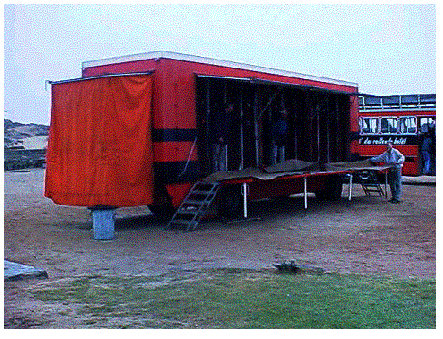
Rollende Hotel
Can you imagine it? In rolls truck and trailer – out spring a Teutonic Horde (honestly Schultz, they weren’t from your part – none of them had skis. In fact they were possibly from the Ruhr – the driver was a Prussian though)
Schnell! Schnell! Blitzkrieg on the showers.
Confiscate all the hot wasser, then off to the field kitchen for Blud Wurst und Sauerkraut. Then to bed. The mind boggles.
It went something like this.
“Right Line up!”
“Children on the top bunks, lighties in the middle”
“Beer drinkers and bed wetters, bottom bunks”
“Schmidt!!!”
“Jahwohl, Herr Bussendriver”
“How many beers tonight??”
“Funff, Herr Bussendriver”
“Bottom bunk Schmidt!”
Then the same thing again next morning in reverse.
Raus Raus. Hit the ablutes, confiscate all the lavatory paper (fur snottenblowen unt paddenkrappen), and away they go.
We enjoyed Luderitz, but, as you may imagine the one-night tour trade did put a damper on things, as indeed it had done in all the places we had stayed in so far.
Our last day in Luderitz, Saturday, was highlighted by watching the Bokke win a very convincing victory over the All Blacks (24/23), and in our hometown to boot. We had checked with one of the hotels -Kapps – the day before. Just as in Keetmanshoop, no problem. In fact we had one of their meeting rooms all to ourselves.,
On Sunday we left Luderitz and came here to Klein Aus, about 130 k inland, and we can really say that we have found the sort of place that we have been looking for – undoubtedly a little bit of heaven. The camp is on a 10,000 hectare farm run by the Swieger brothers. Apart from their farming activities they run horse and hiking trails in the more mountainous part of their property and they also have a camping/caravan park with 10 sites tucked away in the mountains themselves and on the edge of the dunes. They also maintain the watering trough for the wild horses of Garub.

Wild Horses at water trough
The site fees are R 50 per night. Each site has its own tree, water tap, and braai and the ablutes are built of stone and designed to blend into the hill side. Ablutes have hot showers, heated by gas, and are quite larney.
Tonight we are the only people here and the only noises we hear are barking geckoes and the odd jackal.
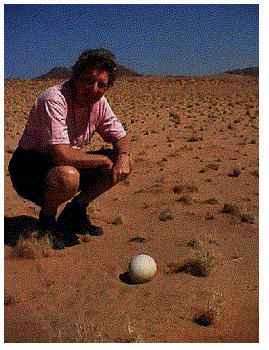
Jean and Ostrich egg.
We have the run of the farm. For the past two days we have been driving out in the Landy and exploring. Literally, sand dunes, mountain passes, and dry river beds. Apart from the cattle and sheep, there are Springbok, Gemsbok, Steenbok, Ostriches, Jackal, Bat Eared Fox and all sorts (all those we saw today by the way – including an Ostrich egg,) We had lunch under a tree in a dry river pass some 15 km as the crow flies from our camp site here, and still on the same farm. Now undoubtedly there are some of you cynics out there who are muttering to yourselves “Oh Yeah, and how do they know it was 15 km?” To those we would remind you that Sean is, by profession, a qualified navigator, well versed in obtaining his position by means of dead reckoning, and the heavenly bodies – apart from which, we have a GPS.
The small mountain range that we are in runs parallel to the road and railway line. Just along from our camp site is a series of stone walls set into the mountain side. These were the defensive positions built by the Germans in the 14/18 war and they made a stand there to stop the Brits advancing from the North. Unfortunately, the Brits didn’t play fair and, with the South Africans, came up from the South. The German general made a very sensible tactical decision and happily there was no blood shed.
It’s really a magic place, Lord knows how long we’re going to stay, but when we do move we will gradually move North to Sesriem.